How Sleep Affects Your Hormones and Menstrual Health
Sleep is not merely rest—it is the time when your body performs critical hormonal housekeeping. Every night, as you move through sleep cycles, your brain orchestrates the release of hormones that directly govern ovulation, menstruation, and fertility. When sleep is disrupted, so is this finely tuned endocrine process. Understanding the connection between sleep and your menstrual cycle can help you make informed changes that benefit both your rest and your reproductive health.
How Sleep Regulates Reproductive Hormones
Your body's hormonal system operates on a 24-hour internal clock known as the circadian rhythm. This rhythm is controlled by the suprachiasmatic nucleus (SCN) in the hypothalamus, the same brain region responsible for initiating the hormonal cascade that drives your menstrual cycle.
Melatonin and the Hormonal Cascade
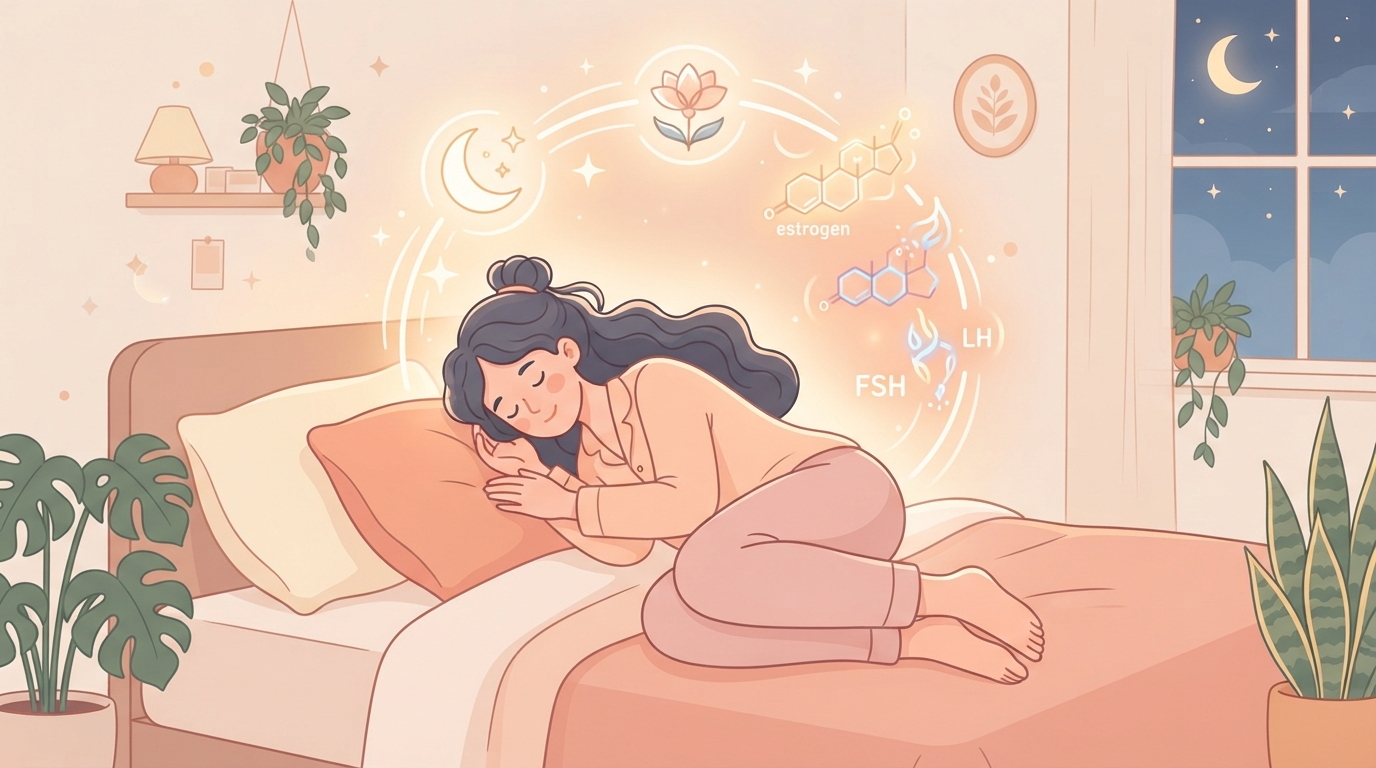
When darkness falls, your pineal gland secretes melatonin, the hormone that signals your body to prepare for sleep. Melatonin does far more than make you drowsy—it acts as a direct modulator of gonadotropin-releasing hormone (GnRH). GnRH, in turn, controls the release of luteinizing hormone (LH) and follicle-stimulating hormone (FSH) from the pituitary gland. These are the hormones that trigger ovulation and regulate estrogen and progesterone production throughout your cycle.
Research published in the Journal of Clinical Endocrinology & Metabolism has shown that disruptions to melatonin secretion—caused by irregular sleep schedules, blue-light exposure at night, or shift work—can suppress GnRH pulsatility, leading to irregular or absent ovulation.
Growth Hormone and Tissue Repair
Deep sleep (slow-wave sleep) is when your body releases the majority of its daily growth hormone. Growth hormone supports the thickening and repair of the uterine lining during the luteal phase. Chronic sleep deprivation reduces growth hormone output, which may contribute to lighter periods or inadequate luteal phase development.
The Evidence: Sleep Disruption and Cycle Irregularities
The clinical evidence linking poor sleep to menstrual dysfunction is substantial:
- Irregular Cycles: A 2017 study in the journal Chronobiology International found that women who slept fewer than six hours per night were significantly more likely to report irregular menstrual cycles compared to those averaging seven to eight hours.
- Worsened PMS and PMDD: Inadequate sleep amplifies the perception of pain and mood disturbances. The American Journal of Obstetrics and Gynecology has documented that women with premenstrual dysphoric disorder (PMDD) experience more severe symptoms when sleep-deprived.
- Shift Work and Anovulation: The World Health Organization has classified night shift work as a probable carcinogen partly due to its circadian disruption. Nurses and healthcare workers on rotating shifts show higher rates of anovulatory cycles, longer menstrual cycles, and increased menstrual pain.
- Reduced Fertility: A study from Fertility and Sterility demonstrated that women undergoing IVF who reported poor sleep quality had significantly lower fertilization rates than those with adequate sleep.
How Your Cycle Affects Your Sleep
The relationship is bidirectional. The hormonal fluctuations of your menstrual cycle can, in turn, alter your sleep quality:
- Follicular Phase (Days 1–13): Rising estrogen levels generally support better sleep quality and more restorative deep sleep during this phase.
- Ovulation (Day 14): The LH surge can slightly elevate core body temperature, which may cause brief nighttime awakenings in some individuals.
- Luteal Phase (Days 15–28): Progesterone rises sharply after ovulation. While progesterone has a mild sedative effect, the simultaneous rise in basal body temperature (0.3–0.5°C) can fragment sleep architecture, reducing the amount of REM sleep you achieve.
- Late Luteal / Premenstrual (Days 25–28): As both estrogen and progesterone drop rapidly before menstruation, many women experience insomnia, vivid dreams, or difficulty staying asleep. This is also when PMS symptoms like cramps and anxiety can further disturb rest.
Tracking these patterns privately can reveal which phase of your cycle is most likely to disrupt your sleep, empowering you to prepare with targeted strategies.
Practical Strategies for Better Sleep and a Healthier Cycle
Improving your sleep hygiene can have a measurable positive impact on your hormonal balance and cycle regularity:
- Maintain a Consistent Sleep Schedule: Go to bed and wake up at the same time every day—including weekends. Consistency reinforces your circadian rhythm and stabilizes GnRH pulsatility.
- Limit Blue Light Before Bed: Screens emit blue-spectrum light that suppresses melatonin production. Stop using phones, tablets, and laptops at least 60 minutes before sleep, or use a blue-light filter.
- Optimize Your Sleep Environment: Keep your bedroom cool (18–20°C / 65–68°F), dark, and quiet. During the luteal phase, when your body temperature is naturally elevated, a cooler room can improve sleep quality significantly.
- Be Strategic About Caffeine: Caffeine has a half-life of approximately five hours. Avoid coffee and caffeinated teas after 2:00 PM to prevent interference with your natural sleep onset.
- Use Magnesium Thoughtfully: Magnesium glycinate may support both sleep quality and the reduction of menstrual cramps. Consult your healthcare provider before starting any supplement.
- Track Your Sleep Alongside Your Cycle: Logging sleep duration and quality alongside your cycle data can reveal powerful correlations. With a private, offline tracker, you can monitor these intimate patterns without worrying about data exposure.
Why Private Tracking Matters for Sleep and Cycle Data
Sleep and menstrual data together paint an extraordinarily detailed picture of your health—and your daily life patterns. This combination of data is precisely the kind of information that should never be monetized or shared without your explicit consent. Cloud-based trackers that sync your sleep patterns, cycle dates, and symptom logs to remote servers create a digital profile that can be accessed, breached, or sold.
An offline-first approach ensures that your sleep and cycle data stays encrypted on your device. You get the full analytical power of pattern recognition without any of the privacy risks.
FAQ
Can pulling one all-nighter affect my period? A single night of total sleep deprivation is unlikely to cause a missed period on its own. However, it can temporarily suppress LH pulsatility and elevate cortisol, which may delay ovulation by a day or two if it occurs during your follicular phase. The cumulative effect of repeated poor nights is far more significant than a single episode.
Why do I sleep worse right before my period? In the late luteal phase, both estrogen and progesterone levels drop rapidly. Progesterone has mild sedative properties, so its withdrawal can cause insomnia. Additionally, the decline in estrogen can increase nighttime awakenings. PMS symptoms like cramping and anxiety further compound the problem.
Does melatonin supplementation help with cycle regularity? Some preliminary research suggests that low-dose melatonin (0.5–3 mg) may support reproductive hormone balance in women with disrupted circadian rhythms, such as shift workers. However, the evidence is not yet robust enough for a general recommendation. Always discuss supplementation with your healthcare provider, especially if you are trying to conceive.
How many hours of sleep do I need to protect my cycle? Most reproductive endocrinologists recommend seven to nine hours of uninterrupted sleep per night. Consistently sleeping fewer than six hours is associated with higher rates of cycle irregularity, worsened PMS, and reduced fertility.
Protect Your Cycle by Protecting Your Sleep
Your sleep and your menstrual cycle are deeply intertwined biological systems. Prioritizing consistent, quality sleep is one of the most impactful things you can do for your hormonal health. With Ayla, you can track both your cycle and your symptoms privately, identifying the patterns that matter—without ever sending your data to the cloud.
Start tracking your cycle privately and securely. Download Ayla today.
Citations
- National Health Service (NHS). (2024). Insomnia.
- Centers for Disease Control and Prevention (CDC). (2024). Sleep and Sleep Disorders.
- American College of Obstetricians and Gynecologists (ACOG). (2015). Menstruation in Girls and Adolescents: Using the Menstrual Cycle as a Vital Sign.
- World Health Organization (WHO). (2024). Physical Activity – Sleep.
- Office on Women's Health, U.S. Department of Health and Human Services. (2021). Premenstrual Syndrome (PMS).